By Lewis Perdue
“Whether it’s from plastic water bottles or all of the things that we eat that are packed in plastic that absorb a lot of those chemicals from the plastic wrapping, even in organic food that is stamped [organic] the BPAs travel through the plastic.” — Robert F. Kennedy Jr. in Children’s Defense Fund interview
And yet! Almost every food item in the new 2025-2026 Nutritional Guidelines under JFK Jr’s purview is wrapped, shipped or contained in plastic!
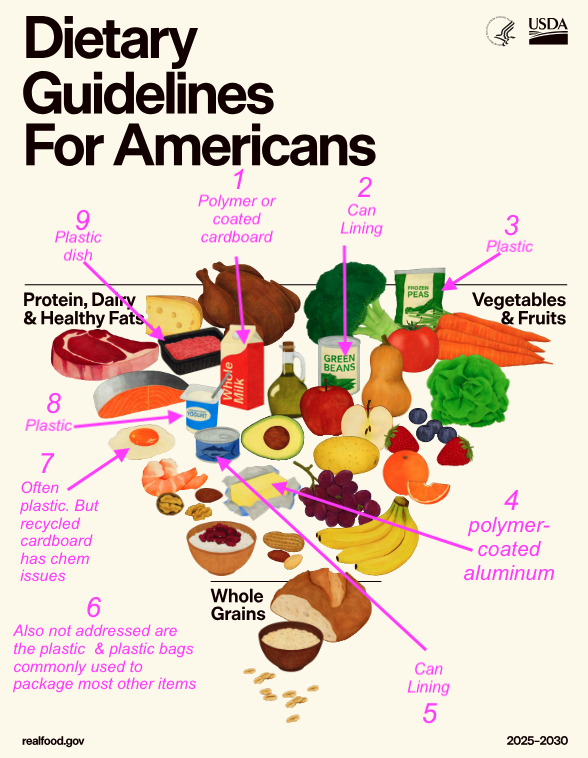
ILLUSTRATED ABOVE: Annotated cover of the 2025-2030 Dietary Guidelines for Americans with packaging materials annotated. Every food category depicted arrives through packaging systems introducing chemical contaminants unaddressed by the Guidelines: plastic dishes, polymer or coated cardboard, can linings, plastic containers, recycled cardboard with chemical issues, and polymer-coated aluminum. Also not addressed are the plastic and plastic bags commonly used to package other items. Annotations by the author.
At first glance, a new set of upside-down nutritional guidelines with foods packaged in plastic raises the epistemological question of whether RFK Jr’s brain worm had finally eaten away at his long-held chemicals-in- food obsession.
Or perhaps it was just a senior moment in which he had suddenly and simply forgotten his previous indictments of BPA and other plastics that he and his MAGA movement had previously leveled against all things chemical. Among them a quick selection:
- Evidence for widespread human exposure to food contact chemicals
- Thousands of toxins from food packaging found in humans – research
- Food Packaging and Chemical Migration: A Food Safety Perspective
Leaving brain worms and senior moments aside for a moment, the explicit and implicit health connection of plastics and foods as illustrated on the cover of the new nutritional guidelines may be the most visible indication of the Trump administration’s policy of protecting his petroleum industry allies and financial contributors and a first visible step of clipping RFK Jr’s regulatory wings.
No more evil BPA or lethal chemicals leaching out of food packaging materials both of which point accusatory fingers at their sources. Instead, we have the strikingly visible attempt to connect plastic and healthy food.
Scrubbing RFJ Jr.’s comments, fencing him off with artificial dyes
Further, the connection is symbolic of the administration’s attempt to scrub derogatory comments about plastics and to limit Kennedy’s public reach. Emblematic of this is very public statements and actions surrounding artificial dyes which are visible, involve children, have natural (but less visibly brilliant) substitutes, and are calculated to generate positive press.
On the other hand, absent or greatly subdued now are Kennedy’s previous and highly visible accusations about the evils of BPA and phthalates which are far more prevalent in both food and the environment. Furthermore, those chemicals are far more damaging to humans, have metabolic effects, no easy substitutes, are enormously profitable and visibly symbolic of massive Trump-supporting petrochemical companies.
As a result, the current administration has fenced Kennedy into a politically correct health and chemical playpen, taken away most of his really dangerous verbiage, and anointed him as a Frootloop savior, and guardian of politically safe language and deeds.
And despite Kennedy’s long history of chemical bashing, packaging contamination expose’s those have been were watered down in his 73-page MAHA Report sent to President Trump’s “Make America Healthy Again Commission” on May 29, 2025 and intended to serve as the scientific foundation for the upside-down 2025-2030 Dietary Guidelines for Americans.
Tellingly, while sporadic mentions of BPA and are still visible in the MAHA
Key to The Numbered Packaging Cover Callouts and citations for 2025-2030 Dietary Guidelines for America
One-time caveat: Packaging varies by brand and region, and is often multi-layer (a mix of plastics plus adhesives/inks). Even “lower-concern” plastics can carry chemicals from additives, printing, adhesives, or recycled-content contamination, so the “likely plastic” notes below reflect common real-world candidates, not guarantees.2,3
Callouts by letters in the graphic
A Plastic or plastic-coated cardboard. Typical item in the picture: the milk carton in Protein, Dairy & Healthy Fats. “Polymer or coated cardboard” means the carton looks like paperboard, but the food-contact side is usually a thin polymer lining. Likely plastic: most commonly LDPE (#4) as an extrusion coating/liner on paperboard (sometimes other coatings or films). Why it matters: the food does not really sit against “cardboard”; it sits against the polymer liner, and migration tends to increase with time and, for some migrants, with fat content.2,9
NOTE: Please see chart at end of these callouts, defining plastic numbers and offering a deeper dive into each numbered chemical.
B Can Lining. Typical item: the can labeled GREEN BEANS in Vegetables & Fruits. A Can Lining is a thin polymer coating inside the metal can (often grouped as #7 “Other” because it is not a single simple resin). Likely plastic: epoxy-type or polyester/acrylic can coatings (often #7 “Other,” depending on product). Why it matters: the food contacts the lining, not the metal, and canning plus long shelf storage can increase opportunities for trace lining-related chemicals to migrate into food.11,12
C Plastic. Typical item: the bag labeled FROZEN PEAS in Vegetables & Fruits. Here “Plastic” is the direct food-contact package. Likely plastic: commonly LDPE/LLDPE (#4) or PP (#5) films (often multi-layer). Why it matters: frozen storage is cold, but contact can be prolonged, and printed films can involve inks/adhesives—so packaging becomes an unlisted “co-ingredient” pathway the food-group picture does not show.2,17
D polymer-coated aluminum. Typical item: a foil/laminate-wrapped portion (a common format for individually wrapped foods). “polymer-coated aluminum” usually means a laminate: a plastic outer layer, an aluminum barrier, and an inner plastic seal layer that typically touches the food. Likely plastic: PET (#1) outer layer plus aluminum barrier plus PE (#4) or PP (#5) inner sealant layer. Why it matters: the food-contact surface is usually the inner polymer layer, but laminates also add adhesives and potential non-intentionally added substances (NIAS), increasing chemical complexity.2,10,14
E Can lining. Typical item: the small blue can near the Whole Grains area (standing in for canned foods across the diet). As with #2, Can lining means the food contacts a polymer coating inside the can. Likely plastic: can-lining polymers (often #7 “Other”). Why it matters: this exposure pathway repeats across many food groups, so the issue is less about one can and more about cumulative contact over time and across products.11,12
F Often plastic. But recycled cardboard has chem issues. Typical item in the picture: eggs (often sold either in plastic clamshells or paperboard cartons). The point of the callout is the tradeoff: packaging is Often plastic.
But recycled cardboard has chem issues because the fiber streams can carry residues from inks/coatings or legacy contaminants. Likely packaging: eggs may come in PET (#1). clamshells or recycled paperboard cartons (not a resin-code story, but still a chemical pathway). Why it matters: “paper” is not automatically inert; recycled materials can carry their own chemical baggage, so switching from plastic to cardboard does not always switch off chemistry.8,16
G Plastic. Typical item: the yogurt/dairy cup in Protein, Dairy & Healthy Fats. Here “Plastic” is the container itself (cup and lid). Likely plastic: commonly PP (#5) for cups/lids (sometimes HDPE (#2) depending on the package). Why it matters: dairy is often fatty, and fats can be especially effective at pulling some migrants from food-contact materials over time—so storage time and container choice can shape exposure even when the food is otherwise “healthy.”2,3
H Plastic dish. Typical item: the meat tray in Protein, Dairy & Healthy Fats (the rigid tray holding red meat). “Plastic dish” captures that the tray is not just wrapping; it is a rigid food-contact platform, often topped with a plastic lidding film. Likely plastic: commonly PS/EPS (#6) foam trays, or rigid PET (#1) / PP (#5) trays, plus a lidding film. Why it matters: meat is fatty and can sit in close contact with that Plastic dish for long periods in the cold chain, making it a prime example of how the same food group can come with different packaging-driven chemical inputs.2,22
Also not addressed are the plastic & plastic bags commonly used to package most other items. This callout highlights what the Dietary Guidelines image leaves out: “Also not addressed are the plastic & plastic bags commonly used to package most other items.” Typical items (implied): bread, grains, snacks, frozen foods, and countless other groceries that arrive in bags or inner liners. Likely plastic: most commonly LDPE/LLDPE (#4) bag films, but also PP (#5), PET (#1), and mixed laminates depending on the product. Why it matters: plastic bags and liners create a pervasive, low-visibility food-contact layer that can shape exposure across the entire shopping cart, not just a few “obvious” items.2,7
Footnotes
- ANSI blog: Resin Identification Codes (ASTM D7611). https://blog.ansi.org/ansi/resin-identification-codes-rics-astm-d7611/
- Food Packaging Forum: Packaging Migration Framework (PDF). https://foodpackagingforum.org/wp-content/uploads/2022/08/FPF_Packaging_Migration_Framework_v1.pdf
- Muncke J, et al. Food contact chemicals and human health: a consensus statement. https://pmc.ncbi.nlm.nih.gov/articles/PMC7053054/
- Groh KJ, et al. Overview of packaging-associated chemicals/hazards. https://pubmed.ncbi.nlm.nih.gov/30463173/
- ATSDR: DEHP ToxFAQs (PDF). https://www.atsdr.cdc.gov/toxfaqs/tfacts9.pdf
- General plastics in food packaging context (open access). https://pmc.ncbi.nlm.nih.gov/articles/PMC12641956/
- FDA: Phthalates in food packaging and food-contact applications. https://www.fda.gov/food/food-additives-and-gras-ingredients-information-consumers/phthalates-food-packaging-and-food-contact-applications
- Liao C, Kannan K. Bisphenol A in paper/recycled products. https://pubmed.ncbi.nlm.nih.gov/21939283/
- Food Packaging Forum: Chemicals migrating from polyethylene food packaging (overview). https://foodpackagingforum.org/news/systematic-overview-reveals-chemicals-migrating-from-pe-food-packaging
- Food Packaging Forum Dossier: NIAS (2nd ed., PDF). https://foodpackagingforum.org/wp-content/uploads/2018/06/FPF_Dossier03_NIAS_2nd-edition.pdf
- FDA: Bisphenol A (BPA) use in food contact applications. https://www.fda.gov/food/food-packaging-other-substances-come-contact-food-information-consumers/bisphenol-bpa-use-food-contact-application
- EFSA Journal (2023): BPA re-evaluation. https://efsa.onlinelibrary.wiley.com/doi/10.2903/j.efsa.2023.6857
- California Prop 65 Fact Sheet: BPA in canned and bottled food and drinks. https://www.p65warnings.ca.gov/fact-sheets/bisphenol-bpa-canned-and-bottled-food-and-drinks
- Food Packaging Forum: Review on chemicals migrating from recycled and reusable plastic FCMs. https://foodpackagingforum.org/news/review-finds-hundreds-of-chemicals-migrating-from-recycled-and-reusable-plastic-fcms
- Food Packaging Forum: Hazardous substances in bio-based food contact materials. https://foodpackagingforum.org/news/studies-confirm-hazardous-substances-in-bio-based-food-contact-materials
- Minnesota Pollution Control Agency: BPA and BPS in thermal paper. https://www.pca.state.mn.us/business-with-us/bpa-and-bps-in-thermal-paper
- Food contact chemicals in humans context (same as #3). https://pmc.ncbi.nlm.nih.gov/articles/PMC7053054/
- PET: Antimony leaching example (open access). https://pmc.ncbi.nlm.nih.gov/articles/PMC10609323/
- Food Packaging Forum Fact Bite: HDPE (recycled) migration (PDF). https://foodpackagingforum.org/wp-content/uploads/2025/05/Fact-bite-10-HDPE-1.pdf
- NCI: Vinyl chloride. https://www.cancer.gov/about-cancer/causes-prevention/risk/substances/vinyl-chloride
- IARC: Vinyl chloride. https://www.inchem.org/documents/iarc/suppl7/vinylchloride.html
- ATSDR: Toxicological Profile for Styrene (PDF). https://www.atsdr.cdc.gov/toxprofiles/tp53.pdf
- Recycled plastics contain many organic chemicals/metals (open access). https://pmc.ncbi.nlm.nih.gov/articles/PMC9979653/
- Legacy additives in plastic waste streams (ScienceDirect). https://www.sciencedirect.com/science/article/pii/S092134492030121X
Resin Code Cheat Sheet: Food-Contact Plastics (Atlantic-ready)
| Resin code | Polymer (full name) | Common uses (food + packaging) | Often combined with / contaminated by (typical) | Benzene / Aromatic ring? | Typical additives / NIAS concerns (examples) | Potential migrants / leachables of concern (examples) | Risk Notes. |
| #1 | PET (Polyethylene terephthalate) | Beverage bottles, produce clamshells, rigid trays | LDPE/LLDPE seal layers; PP caps/lids; EVOH/Nylon barriers; PVC contamination in recycling | Yes | Catalyst residues (often antimony)1; acetaldehyde2; oligomers3; processing aids4; inks/adhesives if laminated/printed5,10 | Antimony1 (catalyst); acetaldehyde2; PET oligomers3; plus migrants from caps/liners and printing/adhesives (antioxidants, slip agents, photoinitiators, etc.)4,5,10,17 | Often treated as a ‘cleaner’ food plastic, but processing residues and laminated layers can still add small, hard-to-track chemical inputs over time. |
| #2 | HDPE (High-density polyethylene) | Milk jugs, thicker bottles, tubs | PP caps; LDPE liners; mixed polyolefins in recycled streams | No | Antioxidants/stabilizers4; slip/anti-block agents4; processing aids4; legacy additives/NIAS in recycled content4,17 | Mostly additive-related: antioxidants/phosphites4; slip agents4; low-MW waxes / oligomers6; possible recycled-stream contaminants4,17; migrants from caps/liners17 | Usually a lower-migration workhorse, but recycled content and additive packages can quietly change what contacts food. |
| #3 | PVC (Polyvinyl chloride) | Some cling films, gaskets/tubing (less common for direct food packs) | Plasticizers required for flexibility; contaminates PET recycling | No | Plasticizers (e.g., phthalates/adipates in some uses)8,9; heat stabilizers (organotins/metal soaps)4,7; residual monomers (e.g., vinyl chloride) – regulated concern9 | Plasticizers (phthalates or adipates)8,9; heat stabilizers (organotin/metal soaps)7; residual vinyl chloride traces (if present)9 | Concern is less the polymer itself than the plasticizers and stabilizers often needed to make it usable around food. |
| #4 | LDPE/LLDPE (Low-density polyethylene / Linear low-density polyethylene) | Bags, wraps, inner liners, squeeze bottles | Inner seal layer in PET/PE and foil/PE laminates; mixed films and printing residues in recycling | No | Slip agents (e.g., oleamide/erucamide)4; antioxidants/phosphites4; anti-block agents4; polymer oligomers / waxes6; printing/adhesive residues (if printed/laminated)5,10; potential recycled-stream contaminants (if recycled content)4,17 | Slip agents (oleamide/erucamide)4; antioxidants/phosphites4; anti-block agents4; oligomers / waxes6; printing/adhesive residues (photoinitiators; aromatic amines)5,10; recycled contaminants (if recycled content)4,17 | Thin films can be deceptively complex because inks, adhesives, and recycled-stream contaminants add chemistry beyond the base polymer. |
| #5 | PP (Polypropylene) | Yogurt tubs, microwaveable containers, caps/lids, some films | PET lidding/top webs; LDPE seal layers; HDPE in recycling | No | Antioxidants/stabilizers4; clarifiers/nucleating agents4; slip agents4; PP oligomers / waxes6; printing/adhesive residues (if printed/laminated)5,10 | Antioxidants/phosphites4; clarifiers/nucleators4; slip agents4; PP oligomers6; migrants from lidding/seal layers + printing/adhesives5,10,17 | Often used for heat, but heat plus additives and long contact time is exactly when migration can increase. |
| #6 | PS/EPS (Polystyrene / Expanded polystyrene) | Foam cups/trays, some takeout, some meat trays | LDPE lidding films; mixed contamination in waste streams | Yes | Minimal additives in GPPS/EPS itself; processing aids / colorants possible4; EPS may include blowing agents4 | Residual styrene and related aromatics (e.g., ethylbenzene)15; EPS blowing agent residues4; colorants/processing aids4 | The issue is straightforward: styrene-related residues make this a higher-scrutiny choice, especially with hot or fatty foods. |
Comments are closed.