
FROM SCIENTIFIC RESEARCH:
“Most foods as purchased and consumed are processed to some extent. For this reason, accounts that are critical of ‘processed food’ are not useful — From: “Ultra-processed foods: what they are and how to identify them.” — journal of Public Health Nutrition: 22(5), 936–941
“Diets restricted to unprocessed food would be less diverse and less secure. Foods benefit, and are made more available, when processed by
various harmless methods of preservation; and some processes enhance food quality, non-alcoholic fermentation being an example. Traditional and established cuisines all over the world are based on dishes and meals prepared from unprocessed and minimally processed food together with processed culinary ingredients and processed foods. The issue is not processing. It is ultra-processed foods, the fourth group in the NOVA system of food classification.
AND THEN WE HAVE MIKE TYSON
Mike Tyson’s superbowl ad casting shade on “processed” food is just the latest example of pseudo-scientific fraud to be foisted on the American public in an attempt to satisfy political supporters of Trump’s political supporters by finding clever language loopholes in dietary recommendations and definitions. Significantly, Tyson has no scientific background to enable him to issue a statement on an important the health-related opinion, only a long pugilistic relationship with President Trump.
Just pause for a moment to realize that, according to most prominent global assessment of food processing categories, cooking an egg in a skillet on the stove counts as a process. And to add insult to culinary injury, adding salt and pepper adds to the level of processing injuries. Horrors await if adding cheese to that
Ironically, RFKJr’s new upside down nutritional guidelines food pyramid contains a number of items that violate Tyson’s “avoid processed food” command.
First of all talking about “processed” foods is a pseudo-clever attempt by Trump administration officials to avoid mentioning the phrase”ultra-processed.” That language is too closely identified with plastic-based chemicals have been shown to leach out of plastic packaging. Kennedy made that a visible campaign issue.
Plastic then became a hot topic in the Trump administration due to RFKJR’s decades long demonization of plastic-based chemicals such as BPA and phthalates associated with metabolic and endocrine disorders.
Politically, RFKJr’s sustained assault over plastics has been scrubbed from his remarks along with other politically embarrassing proxy language following appointment as HHS Secretary.
This is because plastics, especially BPA and phthalates have long been major targets of RFKJRs, because they are high-volume plastic chemicals with petrochemicals origins manufactured by major Trump supporters who ponied up $73 million for his last presidential campaign.
Trump’s “Drill Baby, Drill” campaign speech conflicted with RFKJRs’s declaration to eliminate fracking, which he called a major source of harmful plastic chemicals.
As a result. shortly after becoming HHS Secretary, Kennedy’s speech was vigorously scrubbed of many offending offending proxy references including plastic, fracking, BPA, and phthalates [See the great scrubbing URL-TK]. Among those semantic outcasts were mentions of “ultra-processed” foods because they are often packaged in plastic containers, cans with BPA or other chemicals with the ability to leach plastic-derived substances into food.
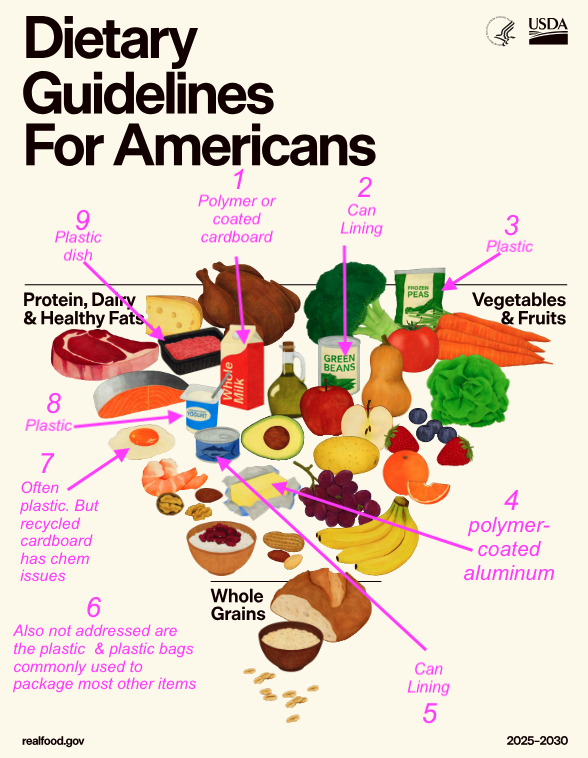
While not directly confirmed, the most visible rehabilitation of plastic can be found in the illustration accompanying the latest government nutrition guidelines which clearly demonstrate healthy foods in plastic packaging — all of which are capable of leaching chemicals. What better way to cast Pollyanna hues all over the evil pre-Trumpian plastic packaging?
No Scientific Definition of “Processed Food.”
The most widely accepted scientific definition of ultra-processed food (UPF) comes from the NOVA classification system that categorizes foods based on the extent and purpose of industrial processing rather than their nutrient content.
Processing: Four categories
“Processed food’ is not a useful or scientifically accurate term because
Because most foods as purchased and consumed are processed to
some extent. For this reason, accounts that are critical of
‘processed food’ are not useful.
The “Cooking” Spectrum
This table demonstrates how a single base food (the potato) moves through the NOVA categories depending on what is added and how it is prepared.
| Action / Component | NOVA Group | Classification | Role in the Diet |
| A whole potato (raw or boiled in water) | Group 1 | Unprocessed / Minimally Processed | The base food/nutrient source. |
| Olive oil and Salt | Group 2 | Processed Culinary Ingredient | The agent used to cook/season Group 1. |
| Homemade roasted potatoes (Group 1 + Group 2) | Group 3 | Processed Food | A traditional culinary preparation. |
| Mass-produced “Tater Tots” (with dextrose, sodium acid pyrophosphate, and hydrogenated oils) | Group 4 | Ultra-Processed Food | An industrial formulation ready to heat. |
Scientific Source
Title: Ultra-processed foods: what they are and how to identify them
Citation: Monteiro, C. A., Cannon, G., Levy, R. B., Moubarac, J. C., Louzada, M. L., Rauber, F., Khandpur, N., Cediel, G., Neri, D., Martinez-Steele, E., Baraldi, L. G., & Jaime, P. C. (2019). Ultra-processed foods: what they are and how to identify them. Public Health Nutrition, 22(5), 936–941.
Date Accessed: February 9, 2026
Classification, Ultra-processed: NOVA Group 4, Direct quote from above (cambridge.org)
Ultra-processed foods are defined as industrial formulations typically composed of five or more ingredients. a food item generally meets the following criteria:
-
Industrial Ingredients: They contain substances extracted from foods (such as casein, lactose, whey, and gluten) or derived from further processing of food constituents (hydrogenated oils, hydrolyzed proteins, maltodextrin, and high-fructose corn syrup).
-
Cosmetic Additives: The use of “markers of ultra-processing”—additives specifically intended to make the product hyper-palatable or visually appealing. This includes flavor enhancers, color stabilizers, emulsifiers, thickeners, and non-sugar sweeteners.
-
Sophisticated Processing: They undergo industrial techniques with no domestic equivalent, such as extrusion, molding, and pre-processing by frying or baking.
-
Nutritional Profile: UPFs are typically characterized by high energy density, high glycemic load, and a lack of dietary fiber, micronutrients, and bioactive compounds.
Common Examples of Ultra (way beyond just) Processed Foods
-
Mass-produced packaged breads and buns.
-
Reconstituted meat products (nuggets, fish sticks, sausages).
-
Instant “cup” noodles and powdered soups.
-
Sweetened breakfast cereals and energy bars.
-
Artificially flavored yogurts and dairy drinks.
Comments are closed.